INDIA DESIGN FESTIVAL (IDF) + USID Conference
: DEMOCRACY

2015, New Delhi (NCR), INDIA
INDIA DESIGN FESTIVAL (IDF) is a lively platform in the Design World, from product to architecture, from strategies to visual experimentation. IDF is a rich surprise that is beyond boundaries of disciplines and limitations of media. It should be a place to experience; meet old friends again, make new ones. IDF will be a weeklong event having a main side event organized in a big city with satellite events across various cities and regions in the country. The satellite events will be organized preferably in parallel to the main event in various
cities/locations/design Institutions across the country. Some events can also be organized pre/post the main event in some of the cities in India. IDF will invite participation not only from design professionals and industry from India, but
also from various design festivals and Design weeks across the world. Each year one International Design Festival/Design Week is nominated as Guest Design Festival/Design Week (e.g Helsinki Design Week, Berlin Design Festival etc.). There will be some theme-focused activities such as Installations, showcase
etc.
We are looking forward to hear from interested individuals, organisations, students, institutions who would be interested in supporting the organisation of IDF as volunteer, supporter and sponsor etc. in making this event successful. Contact usid@usidfoundation.org or call at +91 9695903332
More on IDF & USID Conference
____________________________________________________________________________
Recently Concluded Events
USID GURUKUL 2014
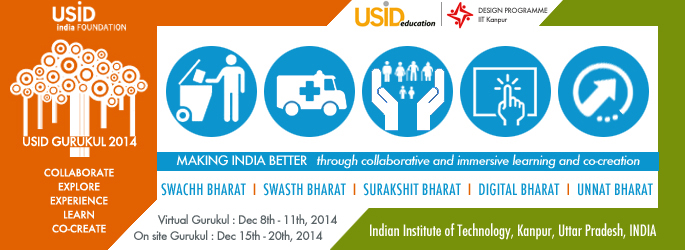
Clean India I Healthy India I Safe India I Digital India I Developed India
USID Gurukul 2014 is 4th in series of Gurukul which is being organised by USID Foundation. USID Gurukul is an inspiration taken from "Gurukul", a school concept from the ancient times in India. USID Gurukul 2014 will bring together around 35 to 40 students who will work on some socially relevant problem space under the mentorship of eminent academicians & researchers and experienced practitioners. Inspired from the new initiatives announced by the honourable prime minster and the government of India such as "Swachh Bharat" and "Unnat Bharat" abhiyan, USID Foundation has decided to include "Making India Better " and "Swachh Bharat (Clean India)", "Swasth Bharat (Healthy India)", "Surakshit Bharat (Safe India)", Digital Bharat (Digital India) and "Unnat Bharat (Developed India)" as the intigral part of the mission and focus of the USID Gurukul 2014.
More on USID GURUKUL 2014

A plugin event for Designers. In this first of its kind convention over 300 visually impaired delegates are expected from all across India. The convention will be a fabulous gathering of host of visually impaired professionals in many disciplines, artists, musicians, academicians and activists. This will be a unique opportunity for Designers to sit back, listen, interact and feel first hand issues that this community feels. Note: Only select 40 Designers / Design Students will be invited to attend.
More on Black Conference
USID Gurukul in School
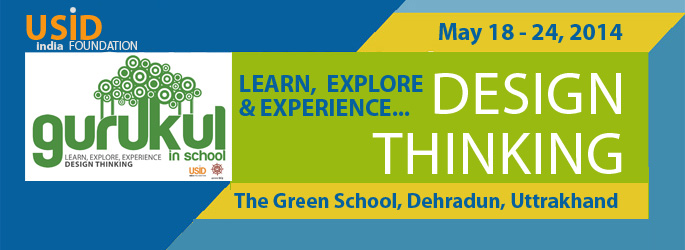
Gurukul in School is an extension of the USID Gurukul to introduce DESIGN THINKING among the SCHOOL CHILDREN and involve them in solving local issues including environment, sustainability, education, future cities, etc through design thinking approach. 29 students of class 6th to 12th from 17th schools across India participated in this workshop. They were divided into number of teams and worked under eminent mentors on various projects like Acid Rain, Furuture of Personal Computer etc. . Gurukul in School also includes talsk, presentations and cultural events.Considering the success and response, USID Foundation is now planning to extend such events to various schools in coming years
More on USID Gurukul in School 2014
____________________________________________________________________________
Past Events
USID 2013 Conference
More on USID 2013
USID 2012 Conference

For more on USID2012 Conference click here
India User Experience (UX) Design Awards 2012

For more on India UX Design Awards 2012 click here
Glimpses of USID2011 Conference
In order to view this object you need Flash Player 9+ support!

Powered by RS Web Solutions
Glimpses of USIDGurukul 2011
In order to view this object you need Flash Player 9+ support!
Powered by RS Web Solutions
Speakers & Presenters from Past Conferences
|
|

|
|

|
|
Bill Buxton
Principal Researcher
Microsoft Research
|
Sharad Sharma
Chief Executive Officer
Yahoo India R&D
|
Debra Danielson
President of CTE,
SVP & Distinguish Engineer,
CA Inc.
|
Prof. M.P. Ranjan
Principal Designer & Faculty,
National Institute of Design,
Ahmedabad (NID)
|
Jennifer Kilian
Creative Director
Frog Design
|

|

|

|

|

|
|
Lalitesh Katragadda
Asst. Managing Director
Google India
|
Dr. Fredrick Weber
Adjunct Sr. Research Scientist
Columbia University Research
Institute
|
Ashish Gupta
Managing Director
Hellion Ventures
|
Prof. Oriville Clubb
Professor
City University of Hong Kong
|
Kentaro Toyoma
Asst. Managing Director
Microsoft Research India
|
|

|

|

|

|

|
|
Prof. Anil K Gupta
Professor IIM, Ahmedabad
Founder-Honey Bee Network
Executive Vice Chairman NIF
Member,National Inno.Council
|
Warren Greving
Director, Srishti Labs
|
Ed Cutrell
Manager, Technology
for Emerging Markets,
Microsoft Research India
|
Santosh Desai
Managing Director & CEO,
Future Brands Ltd.
|
Paul Neervoort
Lead User Experience,
Philips Design
|
|

|
|

|

|
|
|
Solomon Prakash
Country Head
Ashoka, India
|
Dr.Srinivasan Ramani
Professor, IIIT Bangalore
|
Younghee Jung
Research Leader,
Nokia Research Center, India
|
Mahesh Murthy
Founder, Pinstorm
Managing Partner, Seedfund
|
Murli Nagasundaram
Head, Learning Innovation,
Manipal Universal Learning
|
|
|

|

|

|
|
|
Professor Yogesh Atal
Eminent Sociologist
& Anthropologist
|
Sudhir Sharma
Founder and Chief executive
of Indi Design
|
Toyohiro Kanayama
UX Evangelist,
Mitsue-Links Co. Ltd, Japan
|
Aditya Dev Sood
Founder and CEO,
Center for Knowledge
Societies (CKS)
|
Prof KR Srivatsan
Pro Vice Chancellor
IGNOU
|
|

|

|

|
|

|
|
Dr. Jerome White
Researcher
Mobile Research Group
IBM Research Lab
India
|
Dr. Ruchi Dass
Physician,
MHealth Evangelist, India
|
Dr. Carrie Gates
Vice President & Research
Staff Member,
CA Labs, CA Inc.
|
Deepa Bachu
Group Manager
Intuit
|
Dr. Raj Minhas
Asso. Director,
Xerox Research Center,
India
|

|

|

|

|
|
|
Pranav Mistry
Researcher
Media Lab, MIT
|
Dr. Matt Jones
Professort
Swensa University, UK
|
Dr.ChristianLappe
PhD, Director, Sales &
Marketing,SensoMotoric
Instruments (SMI) GMBH
|
Dr. Ed Cutrell
Manager, Technology for
Emerging Markets
Microsoft Research India
|
Uma Prajapati
Upasana Design Studio
Auroville
|
 |

|

|
 |

|
|
Silvia Zimmermann
Founder & CEO
Usability.ch
Switzerland
|
Daniel Scuz
Principle Consultant
Apogee Usability Asia Ltd.
Hongkong
|
Dr.Pramod K Verma
Technology Advisor
UID of India
Bangalore
|
Priya Prakash
Head of Mobile phone
User Experience
Nokia UK
|
Sean Blagsvedt
Founder, babajobs.com
India
|
|

|

|
|

|

|
|
Name
Title & Organisation
Location
|
Prof. Ganesh Prabhu
Professor of Strategy
Indian Institute of Management, Bangalore
|
Sandeep Datar
Sr. Director
User Experience Design
Yahoo India R&D
|
Arunva Sinha
Chief Product Officer
NDTV Convergys
|
Bill Thies
Resaercher, Technology
for Emerging Markets,
Microsoft Research India
|

|

|

|
|
 |
|
Anita B Punja
Asia Pacific Leader
Learning Content Dev.,
IBM India
|
Deepak Menon
Group Design Manager
Microsoft India Development
Center, Hyderabad
|
Jan Blom
Research Team Leader
Nokia Research Center
India
|
Jay Puller
President & CEO
Pramati Technologies
|
Dr.Mellisa Densmore
Post Doc. Researcher
Technologies for Emerging
Markets, Microsoft Research India
|
 |
 |
|
 |
 |
|
Arvind Lodaya
Founder & Designer
Lodaya Consulting
Bangalore
|
Prasonjit Ganguly
Animator and Film Maker
India
|
Dr. Jayant Chatterjee
Professor
IME, IIT
Kanpur, India
|
Neil Patel
Founder, AwaazDe.com
Ahmedabad, India
|
Khushroo Pasha
Founder, Indian Bolld
Donor,
Nagpur, India
|

|
 |
 |
 |

|
|
Markus Heggi
Founder & CEO
Colayer GMBH
|
Adi Codaty
Head Innovation and R&D
United Healthcare India
|
Hemant Lamba
AuroRE
Auroville
|
Satyaki Roy
Associate Professor
Design Programme
IIT Kanpur
|
Jasson Huang
Founding Principal, Tang
Consulting and Founder &
President,UPA China
|

|

|

|

|
 |
|
Hiren Dalal
Director, Quality & PMO
ITC, CA, India
|
Sanjai K.
Vice President
SAP Labs India
|
Dharmesh Jadeja
Architect, Buildaur
Auroville
|
Sree Unnikrishnan
Head, User Experience Group,
Google India
|
Dr. Alok Bajpai
Consultant Psychiatrist
Regency Hospital
Kanpur, India
|

|

|

|

|

|
|
Kaushal Sarda
Chief Evangelist,
Kuliza Technologies
|
Vijay Taddapalli
AVP & Head UXM Group
Satyam Technologies
|
Natalie Buda Smith
UX Consultant
|
Sunil Shanbag
Documentary Film Maker
Theater Director
|
Raghu Dwarkanath
Head of Product Development
Global Business Div., Intuit
|

|
|
|

|

|
|
Suhasini Ayer
Architect/Designer
Auroville Design Consultant
|
Atul Tiwari
Film Script Writer, Actor
Director
|
Dr. S Ghosal
Professor
NID R&D Campus Bangalore
|
Shashank Deshpande
President
Clarice Technologies
|
Paromita Vohra
Documentary Film Maker
Film Director
|
 |

|

|

|

|
|
Dr. Arun Mehta
Professor & Chairman
CE Department, JMIT
|
Prabhas Sinha
Sr. Manager,
Product Management
ITC, CA India
|
Sridhar Marri
VP- & Head, Corp. Comm.
Design Group
Infosys Technologies
|
Dr. Dinesh Katre
Group Head, National
Multimedia Resource Center
C-DAC Pune
|
Saurabh Karandikar
Creative Head
Rediffusin - Y&R
|

|
|

|

|
|
|
Amit Pande
Sr. Manager, Oracle
Applications User Experience
|
Sandeep Pallai
Creative Head
OnMobile Golabl Ltd.
|
Ravi Pudi Krishna
Sr. Head PTL-U
Trina Systems
|
Vineet Malhotra
Co-founder
apnakoi.com
|
Rajiv Puranaiy
Founder & CEO
Hooeey
|

|

|

|

|

|
|
Abhishek Hazra
UX Designer
Microsoft India Development
Center, Hyderabad
|
Prakash Siyani
Forum Nokia, India Lead
Nokia India
|
Mrinal Wadhwa
Founder Blu
|
Uday M. Shankar
Sr. UX Designer
Nokia R&D
|
Asim Waqif
Architect & Installation Artist,
Faculty, School of Planning
& Architecture, Delhi
|